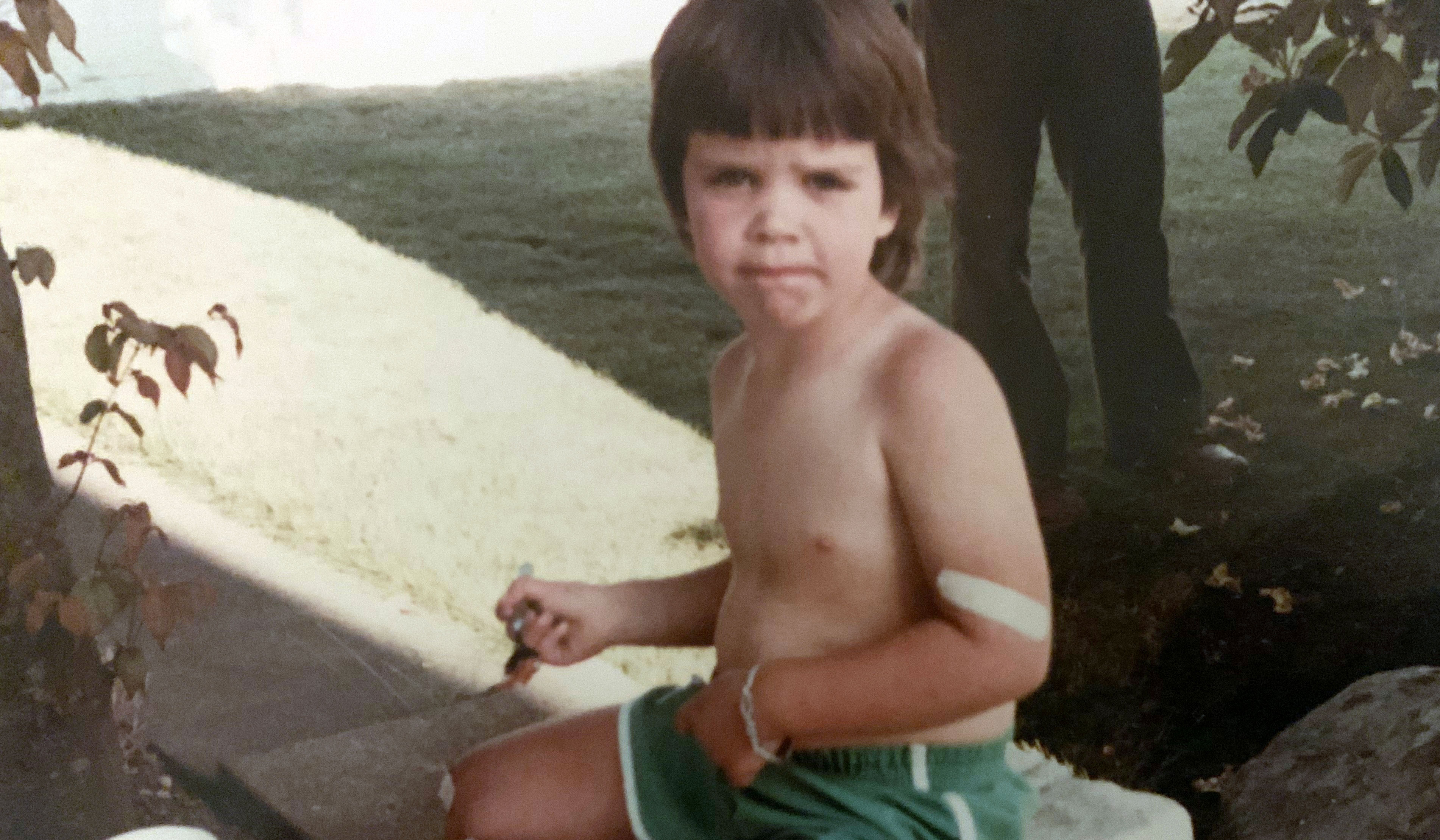
I am not very comfortable telling my story because it requires a vast amount of vulnerability. That, in itself, has been my greatest fear in life.
I grew up in a house of physical, mental, sexual, and emotional abuse—from multiple people. In short, my family, home, security, safety net, trust, love, and my body—were never truly safe from harm.
From my father’s secret visits in the night to my mother’s hot-and-cold treatment—praising me one day, beating me down the next. I learned love meant pain. It meant as soon as I trusted you - it was just a matter of time before you turned around and betrayed me. These were the building blocks of my childhood. That I could trust nobody. Not even my older sister, who followed my mother’s lead—punching down as a way to pass on her pain.
You get the picture. Trust is not something I generally have with people.
In one way or another, that self-fulfilling prophecy played out through my childhood, early adulthood, my marriage, my friendships, my business relationships, and the ways I allowed myself to be treated. Even now, I catch myself in unsafe territory—having to carefully eject myself from certain situations.
“I am a healer, but for most of my life, I have been a wound.”
I have been unique—different—my whole life. I have always stood slightly outside normative culture, living an alternative experience. I have had to figure things out on my own, following my heart since inception.
I grew up gay in the 1980s in Seattle, Washington. It was a liberal, progressive town. My parents were ex-hippies, educators by trade, and politically left. My parents had books like " Our bodies Ourselves," that we read. They walked around naked at our family cabin. In that sense, it was as safe a place as any back then to come out.
Still, I didn’t know any gay people—except Michael, my mom’s coworker, who performed in a gay play at ACT Theatre that I once attended. It was all gay men, so I didn’t make the connection. It would take me until I was 20 years old to fully realize I was queer. When I did come out, I cried and my mom said “It would have been fine with her if I’d fallen in love with a dog.”
"I was asked almost everyday if I was a boy or a girl on the playground."
One memory my mother and sister loved to retell: I was still in a high chair, sitting at the dinner table after yet another round of high-stakes verbal combat. My father—the dominant professor—had been holding court. I looked at him and asked, point-blank, “Dad, how come you’re always right—even when you’re wrong?”
My mouth has gotten me into trouble that way most of my life.
The effect incest has on someone as young as my sister and me—ages zero to two and a half—is hard to unpack. It’s so deeply ingrained into the nervous system that I’m not sure it can ever be fully unwound.
My baseline is that being sexually violated is normal. As unconscious as breathing, crying, or urinating—the basics learned at the same time. This predates conscious thought. Before language. Before understanding the difference between my hand and yours.
I didn’t have to learn how to be molested the way I learned to tie my shoes or ride a bike. It didn’t begin in a classroom. It is woven into the core of my being: that I don’t matter—not when someone else is present.
“Telling my body to relax is like telling a hummingbird mid-flight to chill out.”
For years, I had no idea that I deserved to receive pleasure—let alone an orgasm. It is still complicated for me. My body remains on high alert, just as it was programmed to be. A good soldier, knowing people are unsafe.
I have done a great deal of healing work, but the veil is thin. One wrong move, and the scab comes right back off.
And yet—after all of this—I still follow my heart.
It is a sacred, patchy path. Written in the stars—this rocky road has served its purpose.
Today, I am whole.
I was designed to do this work—to navigate all that life can throw at you, while finding meaning, purpose, and alignment.
I am a textbook case—through the lens of the mental health index—of someone labeled “untreatable.” In a sense, there is a lingering truth to that. Like addiction, this can sneak up on you if I’m not paying attention to the signals.
However, from a heavenly perspective, all wounds can heal. That is the key. There is a way to unwind the damage—no matter how irreparable it may seem, even if the trauma began in infancy.
In many ways, my upbringing has given me an edge.
It has sharpened my perception of others, giving me a different way of seeing. I can see beneath the façade to the core of a person—understanding what truly matters for my well-being: whether someone is a good partner, what they need to understand, and how to keep them safe.
Because I never had a truly safe home, I became more open to constant change—always alert to safety, always scanning for the next step.
It has helped me notice when something is out of place.
Because I can see into the future, it has given me patience.
Having lived through some very hard things has made me incredibly strong.
And knowing just how hard things can get has blessed me with an enormous sense of humor—which helps when I open up to people.
"As a baby I was nicknamed the Budhha."
I was a psychic child—something my mother and sister encouraged, and my father belittled.
One story my mother loved to tell happened when I was still in diapers. She and my sister were watching a TV show about psychic phenomena and the afterlife when I waddled by and, nonchalantly, paraphrased, “Yes, it’s true—that is what heaven is like.”
By third grade, I was moving between multiple classrooms. I was a gifted student, and my English teacher had us writing poetry. I wrote this:
I am a star
Just an old, old star
And when I die I will become the sun
When the sun dies
I will go to the moon in a rocket
And live till I die.
My classmates were writing poems about their cats, toys, and their homes.
By seventh grade, still preoccupied with understanding the meaning of our existence, I found proof—at least for myself—of the afterlife in Many Lives, Many Masters: The True Story of a Prominent Psychiatrist, His Young Patient and the Past Life Therapy That Changed Both Their Lives by Brian L. Weiss. A book that gave my Jedi Knight dreams a playground.
"My first movie ever was Star Wars in the theater. I saw that movie with my Father. I cried because it was my life."
In high school, I began to rebel. I could excel in school and in sports, but I partied just as hard—searching for answers in drugs and alcohol. I was searching for something beyond myself. I was still closeted, newly transplanted from the city into a small farming community after my parents’ divorce.
That same year, my body began to fail me. I developed tendinitis in my hand, which ended my ability to play basketball—my ticket to Stanford, my dream of playing in Europe. Not long after, I got mono and spent the entire summer confined to my bed, forced into stillness.
That summer cracked something open. It gave me my first epiphany.
I left my high school my junior year and entered Running Start, an early college program. I turned away from sports and found the theater instead. I met "E" my spiritual mentor during this time. She has been my mentor and as close to family as I have on this earth for the past 30 years.
I attended Fairhaven College, a multidisciplinary liberal arts program in Bellingham, Washington. The school had just 300 students. I created my own degree, composed of the things I was most drawn to: art, sustainability, inclusivity, and spirituality.
Fairhaven had no grades, which gave me the freedom to truly explore every whim—to follow curiosity to its furthest edge. I did it with a vengeance. It felt like a self-directed, master’s-level education. I left knowing myself—and believing I had found the path that was mine.
For me, that path was photography—for over twenty years. It combined so many of my talents into a single avenue, and I excelled at it. Photography allowed me to use my intuition naturally, alongside my theater instincts, business acumen, and an innate ability to help people feel seen and healed.
People opened up to me. I learned so much. I felt special—like I could use the Force to open people just enough to capture who they really were. It was magic. And I was paid well for it. A dream come true for a rebellious, sad, hidden victim.
I could be different, and people didn’t care. Being a character was encouraged in that world. Eccentricity was a paid sport—especially if you were a girl. People loved me for being myself.
It was my first true training ground for the role I would later step into.
My power lived in the masculine. I learned how to force doors open—how to make things happen. And it worked. For a while. Until it didn’t. Until the deep, dark core of injustice could no longer stay buried.
I got divorced. Almost immediately, I entered a relationship that was far over my head—with a countess I mistook for a goddess. She played tricks to make me hers. I was gullible, desperate, and—as always—searching for a home.
I tried to hide, but that relationship imploded, taking the rest of my life with it—all within a two-and-a-half-month period. My business partner in a new venture seized that moment as an opening and stole my business—swiftly and unexpectedly.
Then my dog died on Christmas Day.
It was a tragic, fateful avalanche. I remember waking up in disbelief that this was my life. What happened? What had I done wrong?
This was the beginning. This was the beginning of my true journey here on earth. A complete shattering of my universe. I had developed celiac disease a few months before. I should have been hospitalized my Dr said. Calling me
"The most stressed woman in the world."
The years that followed felt at first like running through a burning forest as everything around me collapsed. Friends turned on me without warning. I was completely freaked out—far, far from any spiritual high.
I was desperate to understand what had gone wrong. I sold my house, closed my business, bought a Sprinter van, and hit the road. For the next several years, I lived in and out of that van—developing my spiritual capacities, working with my mentor, shedding my ego and my fight, and learning to find the Force within.
This time, from the feminine.
Money was tight. I had no real income. I was forced into obedience.
It took me years to let go of the need to control everything. For a child of abuse, that desire is a lifeline. It had to be beaten out of me over and over again. I still try to control—but now I know better. If I want to get anywhere, I understand this path requires a request, not a demand.
Even as I write this, I know how futile control is here. This work asks you to drop your ego completely—one hundred percent. And it is never finished.
There is no place where I carry more ego than in my body. I have crafted it to a T—to keep it strong, capable, powerful. A quiet tribute to control. Letting go around this has been the last frontier, and it’s still tender for me.
I like being strong. It makes me feel safe.
I used sports my entire life as a way to prove myself, to be seen. Rock climbing was my last hurrah. People have always thought I was younger because I took such careful care of my body. People were attracted to me for it—for that, and for my power. It made them feel safe. Proud to be with me. Like I was something to be claimed.
Letting that go is the hardest part.
It feels like I am letting my father win—like him, and all the other men in my life who scoffed at my spiritual capabilities, at my self-worth, at the core of my soul. Men and women stuck in the masculine, jealous of me—who got the better of me. Who I allowed to degrade, confuse, scare, and belittle me.
Giving up control over my body feels like my last straw—my final act of surrender to this assignment. Becoming a Chief Wisdom Officer brings every part of you up for review. It is not an easy thing to face.
It feels never-ending.
It feels like I might lose myself.
It makes me feel like a loser.
Like some crazy woman living far off in the woods.
No longer seen as attractive.
As if my value has deteriorated—
As if my worth is still measured through the masculine.
That I will be seen as worthless.
Scorned for not looking right.
"In a world I am here to transform."
A world where it feels like I must choose between being myself
and wearing the scarlet letter or pretending.
Where I would rather make a joke about myself
than face the truth.
That I may never be taken seriously.
A world where the masculine is the default.
A world where I no longer want to do it the same way.
A world where I refuse to pretend those values are still true.
Here I stand on my tiptoes.
At the precipice of changing the world.
I will sacrifice everything for this.
I choose love over fear.
I surrender to my calling.
"Where I realize I am ready to release my superpowers into the world."